

How Managed Hosting Reduces Stress for Business Owners: A Complete Guide

How Managed Hosting Reduces Stress for Business Owners: A Complete Guide
Primary keywords: managed hosting, managed hosting services, managed web hosting
Running a business today means relying on digital systems more than ever. From e-commerce storefronts and customer portals to internal collaboration tools and marketing websites, uptime, security, and performance are critical. Yet many business owners face mounting stress managing servers, troubleshooting downtime, and keeping pace with security threats and compliance — responsibilities that distract from strategic growth. Managed hosting removes these operational burdens by delivering expert-managed infrastructure, proactive monitoring, and hands-on support so business owners can focus on what matters most: customers, products, and scaling their business.
In this comprehensive guide you’ll learn exactly how managed hosting reduces stress for business owners. We’ll walk through the specific pain points it solves, concrete business benefits, real-world examples, cost considerations, and step-by-step guidance for selecting a managed hosting provider. You’ll leave with actionable insights and the confidence to decide whether managed hosting is the right move for your business.

Why Business Owners Feel Stressed About Hosting
Before examining the solution, it helps to understand the problem. Hosting-related stress typically stems from a few recurring issues:
- Uptime anxiety: Fear of downtime impacting revenue and reputation.
- Security worries: Data breaches, ransomware, and compliance obligations.
- Technical complexity: Server management, updates, and performance tuning require specialist skills.
- Unpredictable costs: Unexpected incidents drive up support and infrastructure spend.
- Resource constraints: Small IT teams (or none) make 24/7 coverage unrealistic.
- Vendor fragmentation: Multiple vendors and unclear responsibilities create friction during incidents.
- 24/7 monitoring and incident response
- Security hardening, patch management, and backups
- Performance optimization and scaling
- Managed databases, CDN integration, and caching
- Dedicated technical support and account management
- Compliance assistance for standards like PCI DSS, HIPAA, or GDPR
- 24/7 monitoring eliminates the “middle-of-the-night” worry about outages.
- SLA-backed uptime reduces uncertainty — you know the target and remedies if it’s missed.
- Regular automated checks and synthetic transactions validate customer-facing flows.
- Continuous security patching and vulnerability management
- Web application firewalls (WAF), DDoS protection, and intrusion detection
- Encrypted backups, secure key management, and role-based access control
- Assistance with compliance documentation and audit-ready configuration
- Qualified engineers handle server tuning, deployments, and incident resolution.
- Knowledge transfer and documentation help internal teams learn best practices.
- Because experts manage your stack, you avoid costly trial-and-error mistakes.
- Transparent pricing makes forecasting easier.
- SLA credits or penalties offer financial recourse if the vendor fails to meet commitments.
- Outsourcing reduces the need for expensive full-time hires.
- Planned scaling avoids over-provisioning and under-provisioning both of which cause stress.
- Load testing and performance reviews identify bottlenecks before peak demand.
- Result: 18% revenue increase during promotions.
- Owner impact: No emergency calls during sales, ability to focus on marketing strategy.
- Result: Successful audits and faster client onboarding.
- Owner impact: Reduced anxiety over legal exposure and smoother sales cycles.
- Result: MTTR decreased by 60% and SLA compliance improved.
- Owner impact: Lower churn, better customer satisfaction, less time spent firefighting.
- SLA and uptime guarantees — Clear uptime targets, response times, and remediation credits.
- Monitoring and incident response — 24/7 monitoring, escalation paths, and proactive support.
- Security capabilities — WAF, DDoS protection, patching cadence, and compliance experience.
- Support model — Dedicated account manager? Support tiers? Access to senior engineers?
- Backup and recovery — RPO/RTO objectives, encryption, and tested restore procedures.
- Scalability options — Autoscaling, load balancing, CDN integration, and capacity planning.
- Transparency — Reporting, dashboards, and real-time metrics access.
- Pricing and predictability — Fixed monthly fees vs. variable cloud costs and overage policies.
- Onboarding and migration support — Migration assistance, validation, and rollback plans.
- Reputation and references — Customer case studies, third-party reviews, and uptime history.
- Downtime cost: (Average revenue per hour) × (hours of downtime prevented annually)
- Support cost savings: Salary and overhead saved by not hiring full-time DevOps personnel
- Time saved: Hours the leadership and technical team avoid spending on infrastructure × hourly rate
- Risk reduction value: Estimated cost avoided from potential data breach or compliance fines
- Customer retention impact: Reduced churn due to higher reliability and faster support
- Annual revenue: $3,000,000
- Average revenue per hour: $3,000,000 / (365*24) ≈ $342
- Annual downtime reduction: 10 hours
- Downtime cost avoided: 10 × $342 = $3,420
- Support salary saved (one DevOps): $120,000/year
- Time value recovered for leadership (200 hours/year at $200/h): $40,000
- Combined tangible benefits justify typical managed hosting fees and provide significant intangible stress reduction.
- Audit current pain points: Document recent outages, security incidents, support bottlenecks, and hours spent on infrastructure.
- Define requirements: Uptime targets, compliance needs, traffic patterns, and budget constraints.
- Shortlist providers: Use the stress-focused checklist to narrow options.
- Request proposals: Ask for SLA details, migration plans, monitoring dashboards, and references.
- Plan migration: Create a phased migration with testing, rollback plans, and performance validation.
- Onboard and document: Have the provider run knowledge-transfer sessions and set up incident playbooks.
- Measure results: Track uptime, MTTR, response times, cost variance, and team time savings.
- How is monitoring configured and what alerts do you provide?
- What is your guaranteed response time for critical incidents?
- Can you show example SLA credits or remediation policies?
- What security controls and compliance experience do you have for our industry?
- How do you handle backups, restores, and disaster recovery testing?
- What is included in support (patching, updates, performance tuning)?
- What is the onboarding process and expected timeline?
- How do you handle cost overruns or variable cloud bills?
- Can we get references from customers with similar needs?
These stressors compound — downtime leads to lost sales and emergency fixes, which increase costs and frustration, while security incidents can cause long-term reputational damage. Managed hosting is designed to address these issues systematically.

What Is Managed Hosting?
Managed hosting is a service where a third-party provider operates, maintains, and supports your web servers and infrastructure. Unlike basic or unmanaged hosting where you’re responsible for the server OS, updates, security, and troubleshooting, managed hosting includes a package of proactive services such as:
Managed hosting can be offered on shared, VPS, dedicated servers, or cloud platforms — with the provider delivering operational expertise and SLA-backed reliability.

How Managed Hosting Directly Reduces Stress — Key Benefits
Below are the primary stress-relief mechanisms managed hosting provides, each tied to common business pain points.
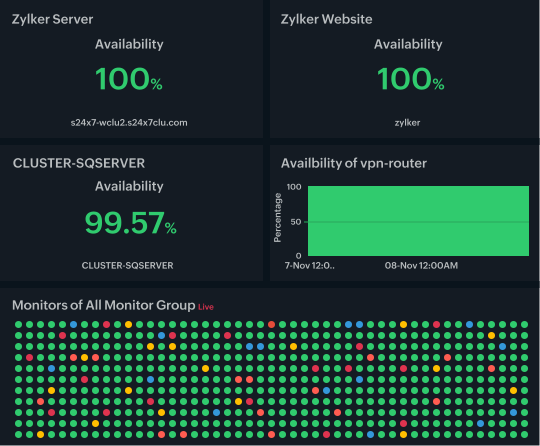
1. Guaranteed Uptime and Proactive Monitoring
Managed hosting providers offer continuous monitoring of servers, applications, and network health. Advanced alerting, automated self-healing scripts, and on-call engineers mean incidents are detected and often resolved before they affect users.
Result: less surprise downtime, fewer emergency wake-up calls, and predictable service levels.

2. Security and Compliance Are Handled
Security is a top stressor. Managed hosting reduces this burden by providing:
Rather than scrambling after a breach, business owners gain assurance that security best practices are built into their hosting environment.

3. Access to Expert Support and DevOps Skills
Many small and medium-sized businesses cannot hire full-time DevOps engineers. Managed hosting gives you that expertise on demand.
Result: faster issue resolution, fewer misconfigurations, and less reliance on in-house technical resources.
4. Predictable Costs and Better Budgeting
Managed hosting typically consolidates infrastructure, maintenance, and support into a monthly fee. This predictability relieves financial stress caused by one-off emergency expenses.
5. Faster Scaling with Less Risk
Managed hosting providers help plan and execute scaling strategies — vertical scaling (bigger servers) or horizontal scaling (more instances). They provide autoscaling orchestration, performance tuning, and capacity planning so traffic spikes don’t become emergencies.
6. Time Savings and Focus on Core Business
With infrastructure operations managed, business owners and internal teams reclaim time to focus on product development, customer engagement, and strategy — the activities that drive revenue and competitive advantage.
Time saved from not managing hosting translates directly into reduced cognitive load and improved decision-making capacity.
Real-World Examples and Case Studies
Concrete examples illustrate how managed hosting relieves stress and drives business outcomes.
Case Study 1: E-commerce Growth Without the Midnight Panic
A mid-market e-commerce retailer experienced frequent downtime during flash sales due to sudden traffic spikes and misconfigured caching. After migrating to a managed hosting provider with an autoscaling cloud architecture and CDN integration, downtime dropped to near-zero during peak events.
Case Study 2: Healthcare Startup Achieves HIPAA Compliance
A healthcare SaaS startup needed HIPAA-compliant infrastructure but lacked security expertise. The managed hosting provider implemented encryption-at-rest, dedicated VPCs, logging and retention policies, and supported the startup through audit documentation.
Case Study 3: B2B SaaS Reduces MTTR and Improves Customer Trust
A B2B SaaS company had a small dev team and long mean time to repair (MTTR). After switching to managed hosting, the provider’s on-call engineers handled incident triage and remediation, and implemented post-incident reviews.
How to Evaluate Managed Hosting Providers (Stress-Focused Checklist)
Choosing a provider reduces stress only if the provider is reliable and aligned with your needs. Use this checklist to evaluate options:
Prioritize the items that map most closely to the stressors you currently face (e.g., if security is your primary concern, emphasize compliance and incident response capabilities).
How to Calculate ROI and Stress Reduction Value
Quantifying the value of managed hosting helps justify the decision. Consider these metrics:
Example quick calculation:
Common Objections and Rebuttals
Business owners often raise concerns before adopting managed hosting. Here are common objections with persuasive rebuttals.
“It’s too expensive.”
Consider total cost of ownership (TCO). When you factor in salaries, downtime, security incidents, recruitment costs, and the opportunity cost of leadership time, managed hosting frequently offers a lower TCO and predictable monthly spend.
“We want full control.”
Managed hosting can be tailored — many providers offer hybrid models where you retain control over application-level decisions while the provider manages infrastructure and operations. This hybrid approach balances oversight with operational relief.
“Vendor lock-in worries me.”
Choose providers that support standard platforms, provide migration assistance, and maintain clear documentation. Negotiate exit clauses and data exports as part of the contract to mitigate lock-in risk.
Actionable Steps to Reduce Stress with Managed Hosting
Follow these steps to transition smoothly and maximize stress reduction.
Checklist: What to Ask During Sales Calls
Frequently Asked Questions (FAQ)
Is managed hosting right for small businesses?
Yes. Small businesses often lack dedicated DevOps staff, so managed hosting provides enterprise-grade operations and security without the need to hire specialized personnel.
How quickly can I migrate to a managed host?
Migration timelines vary by complexity, but many standard website migrations take 1–4 weeks. Large or highly regulated systems may require 6–12 weeks for planning, testing, and validation.
Will I lose control over my data?
No. Your data ownership remains with you; reputable providers include data export and exit clauses. Determine access controls and encryption policies before signing a contract.
What SLAs should I expect?
Look for uptime SLAs of 99.9% or higher depending on your needs. Also evaluate response time SLAs for critical incidents and time-to-resolution expectations.
Conclusion: Make the Shift from Stress to Stability
Managed hosting is more than a technical purchase — it’s a strategic move that turns unpredictable infrastructure operations into a predictable utility. For business owners, that predictability translates into significantly reduced stress: fewer emergency incidents, improved security posture, reliable performance, predictable costs, and time reclaimed for core business activities. When chosen and implemented correctly, managed hosting becomes a silent partner that protects revenue, reputation, and peace of mind.
Next steps: Audit your current pain points, use the stress-focused evaluation checklist, and request proposals from managed hosting providers that match your uptime, security, and scalability needs.
about the author

Making sure your website stands out in the Great North.
